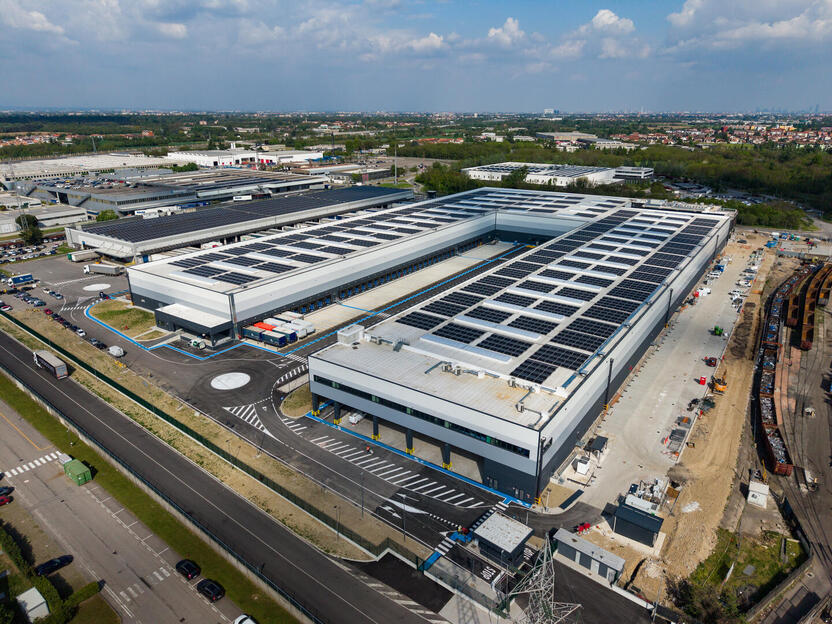
19 November 2026 – European logistics is facing a dual challenge: transport demand is growing, while roads and seaports are increasingly reaching their capacity limits. Efficient transport corridors linking different modes of transport are therefore becoming ever more important. Belgian logistics service provider H.Essers demonstrates what this can look like in practice with its new container terminal in Bergen op Zoom, the Netherlands.
The €75 million facility, which was commissioned by the SAE partner in June 2026, is located directly on the Scheldt-Rhine Canal, between the seaports of Antwerp-Bruges and Rotterdam. With an annual handling capacity of 325,000 TEU, it is set to become a key consolidation hub along the North Sea–Rhine–Mediterranean Corridor. Two daily inland waterway services operate to Rotterdam and Antwerp.
INTELLIGENT CONSOLIDATION OF CROSS-BORDER FREIGHT FLOWS
The concept is also relevant to System Alliance Europe: connecting two major European seaports via inland waterways creates additional capacity for international freight traffic. The new terminal makes it possible to consolidate smaller container flows locally and transfer them onto larger inland vessels. These can then reach the seaports with the minimum volumes required. This eliminates the need for additional truck journeys to the port facilities.
"For members of System Alliance Europe, connecting European economic regions is part of their everyday business. Efficient infrastructure and good links to Europe's
major transport corridors are essential for seamless cross-border transport chains and resilient logistics processes," says Tassilo Schneider, CEO of System Alliance Europe. “Bergen op Zoom serves an important gateway function for our alliance.”
MORE RELIABLE AND PREDICTABLE CONNECTIONS
The integration of different modes of transport is also becoming increasingly important from a sustainability perspective. According to H.Essers, shifting freight to inland waterways will eliminate around 260 truck journeys per day in and around Bergen op Zoom. Inland shipping requires significantly less energy per tonne-kilometre than road transport. The new terminal also uses zero-emission gantry cranes and 19,000 solar panels. Ships can access shore-side electricity while docked.
"For our customers, this means faster and more predictable connections between Antwerp and Rotterdam. For the region and Europe, it means less traffic on the roads and a smaller CO₂ footprint per container," says Gert Bervoets, CEO of H.Essers.
The investment highlights one thing: the future of European logistics will not be decided on the roads alone. It will be shaped by the interaction of strong partners, modern infrastructure and different modes of transport.